The doctrine of Pentagram encompasses esoteric concepts, relationships, and historical figures that weave together to form a rich body of mystical thought and practice. By examining the intersections and overlaps between these figures and symbols, we gain insight into the mystical and philosophical traditions that shape the world of this hermetic lineage.
The Convergence of Mystical and Philosophical Traditions
The principles and correspondences within this esoteric current reveal a profound convergence of mystical and philosophical traditions. Eliphas Levi, a prominent French occultist, is deeply connected to the work of Apollonius of Tyana, a 1st-century Greek philosopher and miracle worker. Both figures are associated with the exploration of magnetism, a concept that is closely bound to the Pentagram, a symbol of great importance in various esoteric traditions. The Pentagram, in turn, is connected to the Kabalistic usage of the Pentagram, which is a method of directing magnetism.
This convergence of mystical and philosophical traditions is further evident in the connections between Eliphas Levi and the Ritual of Transcendental Magic. Levi's experiments with the Ritual, as described in the text, reflect a deep engagement with the principles of Haute Magie, a theological and philosophical framework that underlies his magical practices. The Ritual of Transcendental Magic, in turn, is associated with the concept of the Sacred Triad, a symbol of eternal catholism that is deeply rooted in Christian doctrine.
The Pentagram as a Symbol of Unity and Magnetism
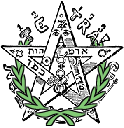
The Pentagram emerges as a central symbol in the mystical and philosophical traditions of this hermetic lineage. It is associated with the concept of unity and magnetism, reflecting the idea that the alignment of thoughts, intentions, and decisions among individuals is crucial for the operation of magnetism. The Pentagram is also connected to the concept of the Sacred Triad, which represents a symbol of eternal catholism.
The Pentagram is linked to various other concepts, including the Kabalistic usage of the Pentagram, the seven metals, white marble, unblemished lambskin, and the consecration of the Pentagram. These connections highlight the manifold nature of the Pentagram, which serves as a tool for achieving unity, directing magnetism, and invoking spirits.
The Importance of Agreement and Will in Mystical Practices
The principles and correspondences within this esoteric current emphasize the importance of agreement and will in mystical practices. The concept of agreement of minds is crucial for directing magnetism, as explained in the text. This idea is further reinforced by the connection between Eliphas Levi's experiments with the Pentagram and Pantacle, which involve achieving agreement of minds and wills.
The concept of complete union of will is also significant, as it is associated with the idea of achieving a state of unity and magnetism. This concept is reflected in the connections between Eliphas Levi, Apollonius of Tyana, and the Ritual of Transcendental Magic, which all emphasize the importance of aligning thoughts, intentions, and decisions among individuals.
Bibliographia & Fontes
Primary Source Books Used in This Article
The doctrines, historical citations, and symbolic correspondences synthesized in this article are drawn from the following primary works and chapters:
- I.Éliphas Lévi, Transcendental Magic: Its Doctrine and Ritual (Dogme et Rituel de la Haute Magie)1856 / 1896 trans.
Translated and Annotated by A. E. Waite
Chapters / Sections Consulted:Part I: The Doctrine of Transcendental Magic · Part II: The Ritual of Transcendental Magic - II.Manly P. Hall, The Secret Teachings of All Ages1928
An Encyclopedic Outline of Masonic, Hermetic, Qabbalistic and Rosicrucian Symbolical Philosophy
Chapters / Sections Consulted:Ch. “Wonders of Antiquity” · Ch. “Ceremonial Magic and Sorcery” · Ch. “Stones, Metals, and Gems” · Ch. “The Cross and the Crucifixion”
Further Inquiry in This Cycle
Companion Studies & Disputations
The Esoteric Synthesis of Eliphas Levi and Apollonius of Tyana
We explore the connections between these figures and symbols, examining the relationships between Levi's magical experiments, the Ritual, and the teachings…
Transcendental Magic and the Paradox of Preparation
In the context of this hermetic lineage, the Ritual of Transcendental Magic and the concept of Preparations are intricately…
The Mystical Significance of the Pentagram
Through a detailed analysis of the relationships among these traditions, including Magnetism, Agreement of Minds, and Complete Union of Will, this…
Nexus: A Philosophical Synthesis of the Pythagorean Tetractys
Through a rigorous analysis of the classical sources and relationships, we will elucidate the symbolic significance of the Tetractys and its utilization by…
Transcendental Magic: Its Doctrine and Ritual (Éliphas Lévi)
The cornerstone of modern occultism and ceremonial magic, expounding the equilibrium of the Astral Light, the Pentagram, and the correspondence of the Twenty-Two Arcana.