At its core, the Ego Sum Qui Sum tradition revolves around the pursuit of truth, wisdom, and spiritual perfection. Through an examination of the surviving literature points, this synthesis reveals the sympathy of these concepts, ultimately pointing to a unified understanding of existence.
The Assertion of Existence: Ego Sum Qui Sum
The phrase "Ego sum qui sum" (I am who I am) serves as a foundational assertion of existence, symbolizing the direct and unmediated expression of being. This concept is closely bound to the Holy Kingdom, representing the ultimate form of sanctity and divine presence. The Emerald Tablet, attributed to Mercurius Trismegistus, further reinforces this idea, as it embodies the principles of transmutation and the correspondence between the macrocosm and microcosm.
The Pursuit of Wisdom: Mercurius Trismegistus and the Emerald Tablet
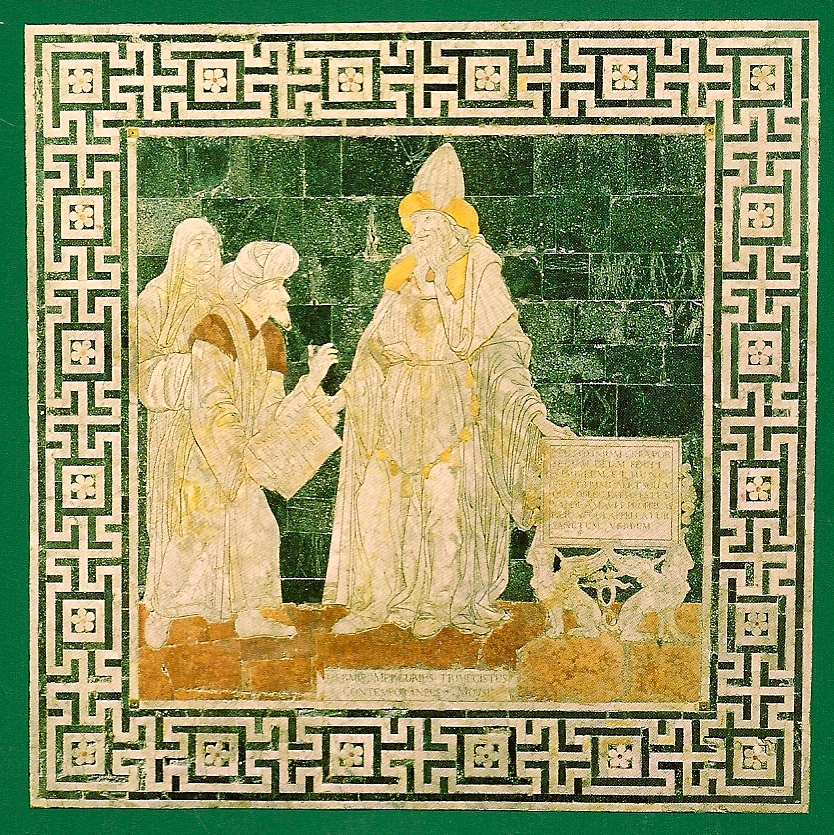
Mercurius Trismegistus, a legendary figure in occult philosophy, is credited with the creation and interpretation of the Emerald Tablet. This text is considered a cornerstone of Hermeticism, providing the foundational principles for direct and rational inquiry. The Emerald Tablet's principles are seen as conduits to the infinite, guiding seekers towards deeper knowledge and understanding of the divine. The connection between Mercurius Trismegistus and the Emerald Tablet highlights the significance of wisdom and knowledge in the pursuit of spiritual perfection.
The Realm of the Sacred: Holy Kingdom and Regnum Dei
The Holy Kingdom and Regnum Dei (Kingdom of God) represent the realm of the sacred, where divine principles and governance reign. These concepts are closely tied to the idea of the infinite, symbolizing the ultimate goals of spiritual and alchemical pursuits. The Holy Kingdom is a realm where true and unmediated science reigns, where divine wisdom and direct experience align to form the perfect path of understanding.
The Path to Truth: True Science and Ego Sum Qui Sum
True Science is a rigorous and direct path to knowledge and truth, rooted in the principles of reason and direct experience. The principle of "Ego sum qui sum" is fundamental to true science, representing the quest for direct and rational understanding. This concept mandates a direct and rational examination of evidence and experience as the path to ultimate truth. The connection between true science and "Ego sum qui sum" reveals the place of intellectual honesty and purity in the pursuit of knowledge.
The Pursuit of Purity: Ego Sum Qui Sum and Purity
The concept of purity is manifold, encompassing spiritual, moral, and physical dimensions. The principle of "Ego sum qui sum" symbolizes a state of purity and sanctity, indispensable for the practice of true science and the attainment of ultimate knowledge. This purity is not merely a physical or external condition but a deeper, internal state of being—a reflection of one's true self. The connection between "Ego sum qui sum" and purity reveals the place of maintaining a high ethical and philosophical standard in the pursuit of knowledge.
The Unity of Existence
The synthesis of this hermetic lineage reveals a unified understanding of existence, where the pursuit of truth, wisdom, and spiritual perfection are intertwined. The traditional doctrines, concepts, and substances examined in this essay are interconnected, ultimately pointing to a singular reality. The assertion of existence, the pursuit of wisdom, the realm of the sacred, the path to truth, and the pursuit of purity are all facets of a larger whole, demonstrating the unity and sympathy of existence.
Bibliographia & Fontes
Primary Source Books Used in This Article
The doctrines, historical citations, and symbolic correspondences synthesized in this article are drawn from the following primary works and chapters:
- I.Éliphas Lévi, Transcendental Magic: Its Doctrine and Ritual (Dogme et Rituel de la Haute Magie)1856 / 1896 trans.
Translated and Annotated by A. E. Waite
Chapters / Sections Consulted:Part I: The Doctrine of Transcendental Magic - II.Hermes Trismegistus (attr.), Tabula Smaragdina (The Emerald Tablet)c. 8th–12th c.
Classical Primary Source Referenced in Text
- III.Heinrich Cornelius Agrippa, De Occulta Philosophia Libri Tres1533
Classical Primary Source Referenced in Text
Further Inquiry in This Cycle
Companion Studies & Disputations
The Emerald Tablet and the Pursuit of Divine Wisdom
This essay explores the philosophical and esoteric connections between the Emerald Tablet, Mercurius Trismegistus, the Kingdom of God, the Priesthood of…
Ego Sum Qui Sum & True Science: The Unity of Existence
The concepts presented within this esoteric current reveal a profound philosophical framework that weaves together the threads of existence, knowledge, and…
Corpus Hermeticum & Asclepius (Copenhaver Critical Edition)
The definitive scholarly translation of the Greek and Latin Hermetica attributed to Hermes Trismegistus, foundational to Renaissance Neoplatonism and Western esotericism.