Hermetic philosophy, rooted in ancient wisdom, is a complex system of thought that seeks to understand the fundamental laws governing the universe and the relationship between the physical world and the divine. Through a network of interconnected principles and correspondences, Hermetic philosophy offers a profound framework for understanding the mysteries of existence. This synthesis will examine the core principles and teachings of Hermetic philosophy, exploring its connections to various philosophical and mystical traditions.
The Unity of All Things
Central to Hermetic philosophy is the concept of the Unity of All Things. This principle, embodied in the Hermetic Principle of Mentalism, posits that the universe is mental in its essence, and that all things are interconnected and interdependent. The Kybalion, a foundational text in Hermeticism, teaches that the universe is governed by a set of universal laws that apply to all planes of existence. This understanding demonstrates the idea that the physical and metaphysical realms are not separate, but rather, they are intertwined aspects of a larger, unified whole.
The Seven Hermetic Principles
The Seven Hermetic Principles, as outlined in The Kybalion, are the foundational teachings of Hermetic philosophy. These principles, including the Law of Mentalism, the Law of Correspondence, the Law of Vibration, the Law of Polarity, the Law of Rhythm, the Law of Cause and Effect, and the Law of Compensation, provide a framework for understanding the workings of the universe. They offer insights into the nature of reality, the sympathy of all things, and the principles that govern the cosmos.
The Perpetual Lamp of Wisdom
The Perpetual Lamp of Wisdom is a symbol of the enduring Hermetic teachings founded by Hermes Trismegistus. This concept represents the idea that Hermetic knowledge is a continuous, unbroken tradition that has been passed down through the ages. The Three Initiates, who wrote The Kybalion, were initiates of the Hermetic teachings and ensured the perpetuation of this knowledge through their work.
The Three Initiates and Hermes Trismegistus
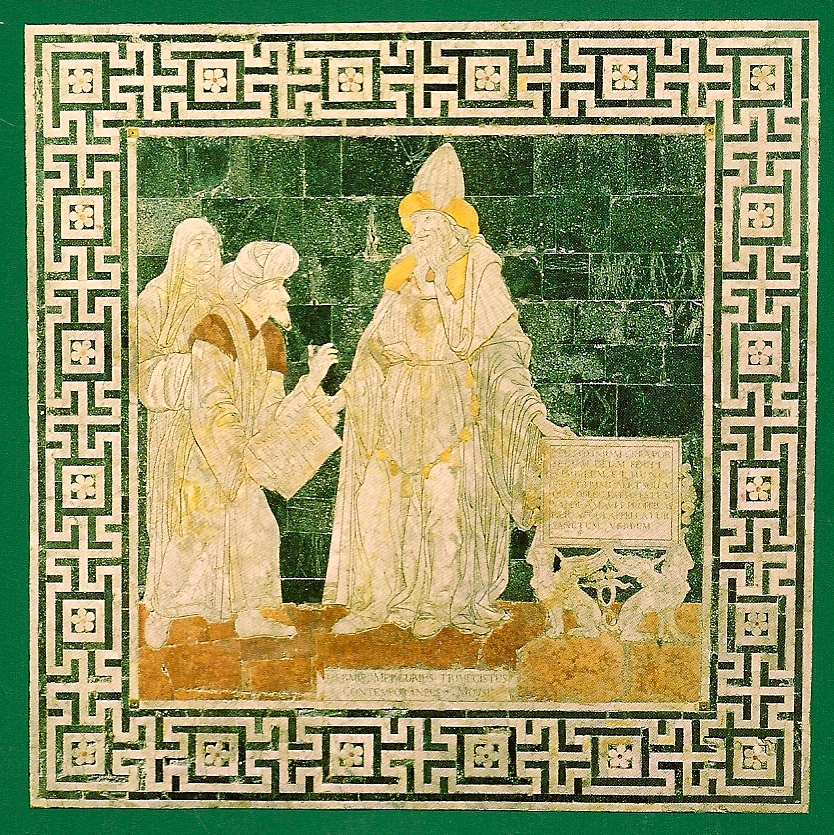
The Three Initiates, who authored The Kybalion, were deeply connected to the Hermetic teachings founded by Hermes Trismegistus. Hermes Trismegistus, a central figure in Hermetic philosophy, is recognized as the founder of this hermetic lineage. The Three Initiates, as initiates of this tradition, carried forward the teachings of Hermes Trismegistus, introducing Hermetic philosophy to a wider audience through The Kybalion.
Gnosticism and Hermetic Philosophy
Hermetic philosophy and Gnosticism share a significant philosophical connection, both drawing from principles that emphasize direct knowledge and understanding as fundamental aspects of their teachings. The Kybalion and Gnostic tradition both explore themes of inner wisdom and spiritual insight, asserting that true understanding and enlightenment can be achieved through direct, intuitive knowledge.
Bibliographia & Fontes
Primary Source Books Used in This Article
The doctrines, historical citations, and symbolic correspondences synthesized in this article are drawn from the following primary works and chapters:
- I.The Three Initiates, The Kybalion: A Study of the Hermetic Philosophy of Ancient Egypt and Greece1908
The Seven Hermetic Principles
Chapters / Sections Consulted:Introduction & Seven Hermetic Axioms - II.Manly P. Hall, The Secret Teachings of All Ages1928
An Encyclopedic Outline of Masonic, Hermetic, Qabbalistic and Rosicrucian Symbolical Philosophy
Chapters / Sections Consulted:Ch. “The Theory and Practice of Alchemy” · Ch. “Introduction to Symbolical Philosophy” · Ch. “An Analysis of Tarot Cards” · Ch. “The Fraternity of the Rose Cross” · Ch. “Fishes, Insects, Animals, Reptiles and Birds” · Ch. “The Elements and Their Inhabitants” - III.Éliphas Lévi, Transcendental Magic: Its Doctrine and Ritual (Dogme et Rituel de la Haute Magie)1856 / 1896 trans.
Translated and Annotated by A. E. Waite
Chapters / Sections Consulted:Part I: The Doctrine of Transcendental Magic · Part II: The Ritual of Transcendental Magic - IV.Max Heindel, The Rosicrucian Mysteries: An Elementary Exposition of Their Secret Teachings1911
The Rosicrucian Fellowship
- V.Arthur Edward Waite, The Pictorial Key to the Tarot1910
Being Fragments of a Secret Tradition under the Veil of Divination
- VI.P. D. Ouspensky, The Symbolism of the Tarot: Philosophy of Occultism in Pictures and Numbers1913
Translated by A. L. Pogossky
- VII.A. E. Thierens, The General Book of the Tarot1930
Containing the Astrological Key to the Esoteric Tradition of the Greater and Lesser Arcana (Intro. by A. E. Waite)
Further Inquiry in This Cycle
Companion Studies & Disputations
Deity, House & Absolute Process in Hermeticism
By examining the relationships among these traditions, such as the HOUSE, DEITY, ABSOLUTE PROCESS, and RELATIONSHIPS OF OPPOSITES, we will gain insight…
The Harmonious Dance of Celestial Bodies and Human Destiny
By examining the sympathies among these principles such as Astrology, Temperance, Prudence, Evolution, and the Clock of Destiny, this analysis reveals a…
Data Points of Kybalion
Central to this synthesis is the Hermetic Principles, which serve as a foundation for understanding the sympathy of various concepts, including Gnosticism…
Hermes Trismegistus: The Unity of Esoteric Knowledge
The doctrine of Hermes Trismegistus encompasses esoteric concepts, entities, and relationships that weave together to form a profound philosophical…
Hermetic Philosophy: The Harmony of Hermetic Wisdom
In the realm of this hermetic lineage, we find a rich body of esoteric concepts, entities, and relationships that weave together to form a profound…
Mental Transmutation, Mental Alchemy & Metal Transmutation in
Central to this philosophical framework is the Hermetic Principle of Mentalism, which posits that the universe is mental in its nature. This fundamental…
Creatures and Self-Mastery in Self-mastery
The doctrine of Self-mastery encompasses philosophical concepts, entities, and relationships that reveal the intricate web of life, highlighting the…
Genius, Brother Hilarion Tissot & Magical Axiom in Hermeticism
The doctrine of Genius encompasses esoteric concepts, entities, and relationships that warrant a deep analysis to uncover the underlying philosophical…
Path & Heathen: The Esoteric Journey
The concepts presented within this esoteric current offer a profound spiritual framework, emphasizing the importance of introspection and self-discovery on…
Corpus Hermeticum & Asclepius (Copenhaver Critical Edition)
The definitive scholarly translation of the Greek and Latin Hermetica attributed to Hermes Trismegistus, foundational to Renaissance Neoplatonism and Western esotericism.